Why personal branding has a reputation problem

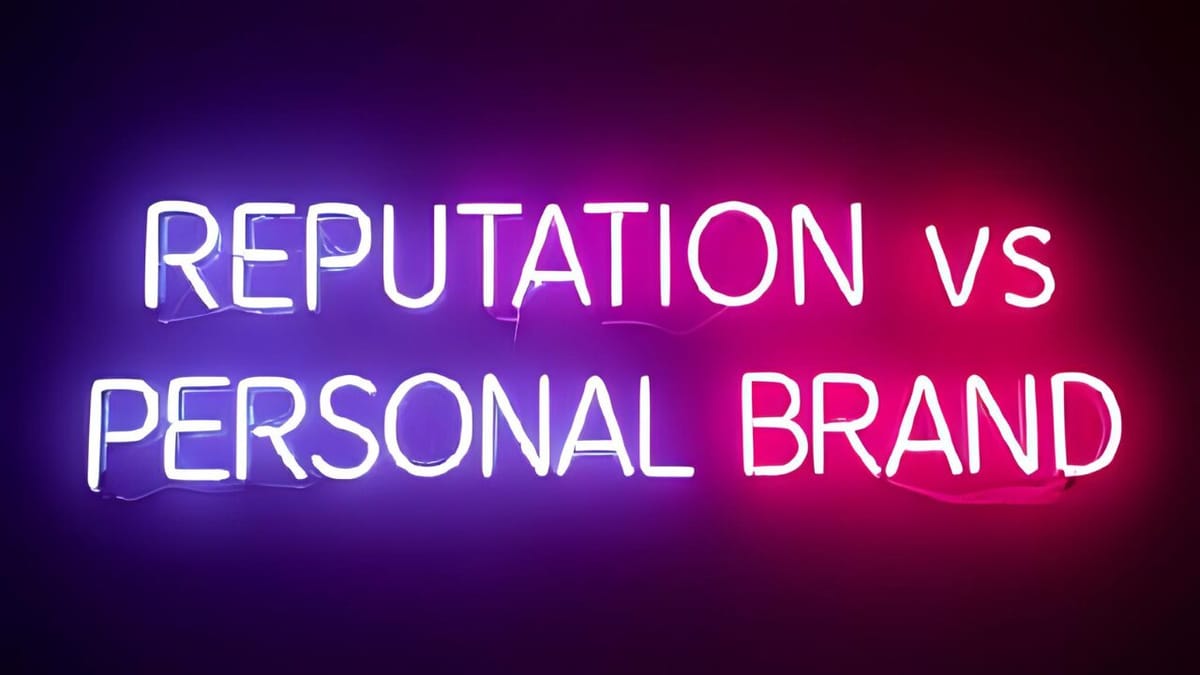
Why is it that some people manage to build large online followings but can't sustain the hype and buzz over time?
It’s because they got things arse-about: They invested heavily in their personal brand before building the reputation to support it, and eventually, the gap between the two became impossible to ignore.
I’ve spent decades working in PR and communications, and I’m also a very keen observer of the Creator Economy and what’s going on in that space. I see this pattern play out all the time in different industries and contexts.
Someone builds an impressive public presence - the visibility, the followers, the speaking gigs, the buzz - but unfortunately, there’s not much underneath to validate the hype.
A dissatisfied customer goes public on Reddit. A promised result doesn’t materialise. A speaking gig attracts criticism. A podcast interview is shallow and turgid. A long-form article falls flat because it contains little original thinking.
Eventually, the whole reputational structure - or lack thereof - collapses under the stress.
Meanwhile, other professionals and entrepreneurs with more modest visibility and followings build enduring influence that compounds over time.
The difference between the two isn’t talent or luck. It’s their understanding what personal brand actually is, what it can and cannot do, and what needs to exist before it’s worth investing in at all.
The personal branding echo chamber
Scroll through LinkedIn and you’ll find endless advice on personal branding: optimise your headline, post consistently, find your niche, build your audience. There’s an entire advice industry built around helping professionals position themselves, craft their narrative, and amplify their visibility.
None of this is wrong, necessarily … okay, a fair bit of it is pretty ‘meh’ 😜 - but it only tells part of the story.

The personal branding conversation has become so dominant that we’ve forgotten the other half of the equation - the part that actually determines whether your business or career is built on bedrock or quicksand.
We’ve conflated “getting noticed” with “building credibility.”
We’ve mistaken visibility for trust.
The result is a generation of professionals who are exceptionally good at looking impressive, and surprisingly bad at being impressive.
They know how to craft the perfect LinkedIn post but struggle to maintain client relationships.
They can grow a decent following by gaming the algorithm, but can’t build a track record that justifies it.
They can produce YouTube videos that attract attention, but hit the wall in terms of taking their thinking (and audience) to the next level.
Yes, they have a personal brand. But what they don’t have is a rock-solid reputation.
Two different forces
A lot of people think reputation and personal brand are the same thing, and use them interchangeably. I know I’ve been guilty of doing that in the past!
So let’s break them down, because the nuances matter.
Reputation is the story others tell about you based on your accumulated actions over time. It’s not something you fully control - it’s influenced by how people interpret what they see from you, again and again.
Put another way: Reputation is built from the evidence trail you leave - how you treat people when there’s nothing to gain, whether you deliver on commitments, how you handle mistakes, what you do when integrity costs you something.
These patterns, repeated across months and years, create the composite picture others hold of your character and competence.
You shape reputation through consistent behaviour. It lives in other people’s memories and interpretations - their experience of working with you, what they’ve witnessed firsthand, what they’ve heard from others they trust.
You can’t manage it like a brand; you can only influence it by showing up with excellence and integrity so reliably that the evidence becomes undeniable.
Your personal brand, on the other hand, is how you want to be known - the specific value and identity you’re claiming in the marketplace.
It’s the deliberate impression you’re building: “the designer who makes complex ideas accessible,” “the entrepreneur who ships fast without breaking things,” “the strategist who asks uncomfortable questions.”
Personal branding is the strategic work of communicating that identity - curating your public presence, choosing what to amplify, deciding how to position yourself differently than others.
You control this narrative directly because you’re actively managing the message before anyone works with you.
Of course, if there is any disconnect - the hype doesn’t match the substance - well, that’s when things get murky, and this can lead to distrust.
Put another way:
Think of reputation as the sturdy foundation of a building, constructed over time and tested by weather and stress.
Personal brand is the intentional architecture and design - the features and aesthetic that attract the right people to that building. It isn’t inherently shallow; it only becomes a problem only when it’s used to compensate for a weak or shaky reputation.
Why the gap kills you
Here’s where most professionals get it backwards: they invest heavily in personal brand but disregard the very thing that’s required to support it - reputation.
This creates what I call the substance-signal inversion.
This is where your marketing sophistication outruns your actual track record. You look impressive on paper, but there’s little in the way of substance underneath.
Increasingly, modern audiences detect this mismatch very quickly. They’ve been burned too many times by polished profiles that couldn’t deliver.
The good news is, a strong personal brand can enhance a good reputation. When you consistently showcase genuine expertise and positive attributes, it reinforces what people already experience working with you.
But a poor reputation will always undermine even the most sophisticated personal brand. No amount of strategic positioning can compensate for broken promises, shoddy work, or ethical failures. The gap between what you claim and what you deliver becomes obvious, and often public.
This is why the hucksters and the wannabes eventually get found out. Without reputation to back it up, the whole structure eventually collapses.
Reputation endures because it’s built on evidence that multiple people can verify. Personal brand alone is just marketing, and everyone knows marketing can lie.
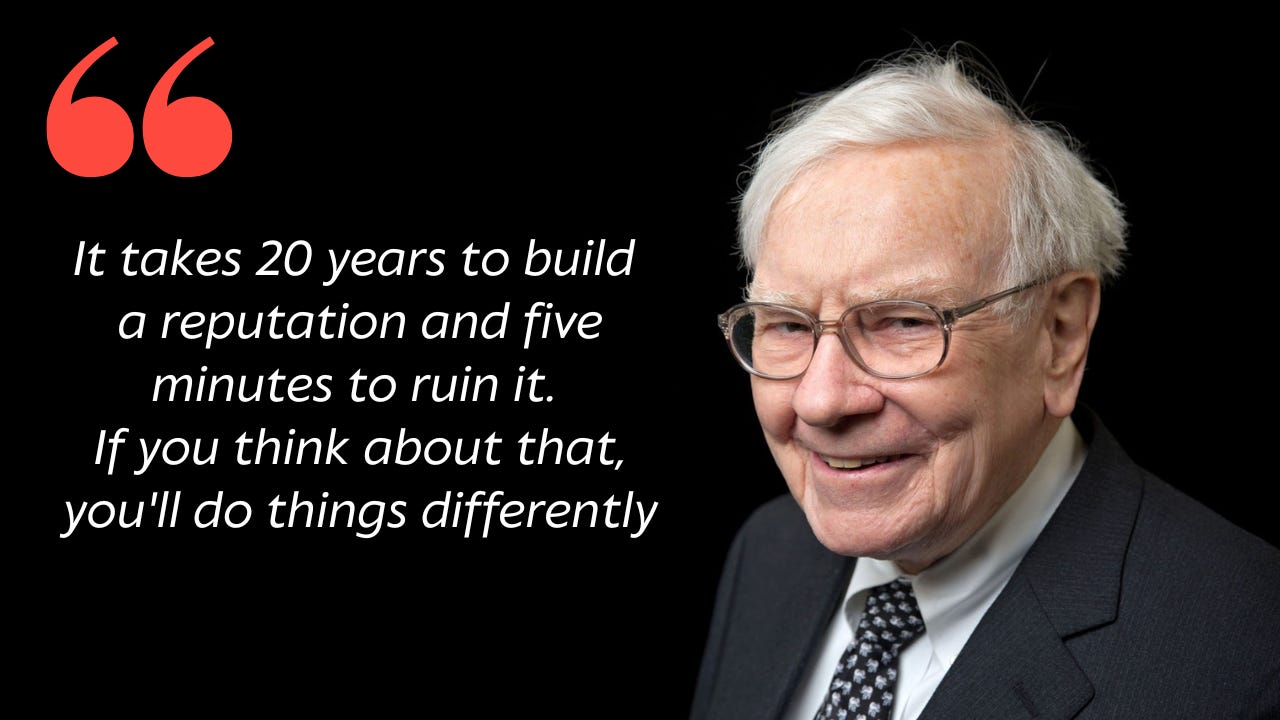
Legendary investor Warren Buffett put it perfectly when he said:
“It takes 20 years to build a reputation and five minutes to ruin it. If you think about that, you’ll do things differently.”
The order that matters: Professional reputation first
The sustainable approach requires a different order of operations.
First, build reputation through relentless competence. Do exceptional work. Solve problems that matter. Keep your word, especially when it’s inconvenient. Show up consistently over months and years. This creates the foundation - the underlying reality that can withstand scrutiny.
Managing one’s reputation can take various forms. For example:
- delivering work that exceeds expectations, especially early in relationships when people are still forming their impression of you
- investing in relationships without immediate reciprocity - making introductions, offering help before you need something, remembering what matters to people.
- communicating transparently by being honest about challenges and mistakes, sharing context openly, giving credit generously, not spinning failures.
- honouring commitments religiously, even small ones that no one would notice if you skipped.
These aren’t tactics - they’re the actual behaviours that cause people to trust you, remember you positively, and vouch for you when your name comes up.
Earned authority: The powerful sweet spot
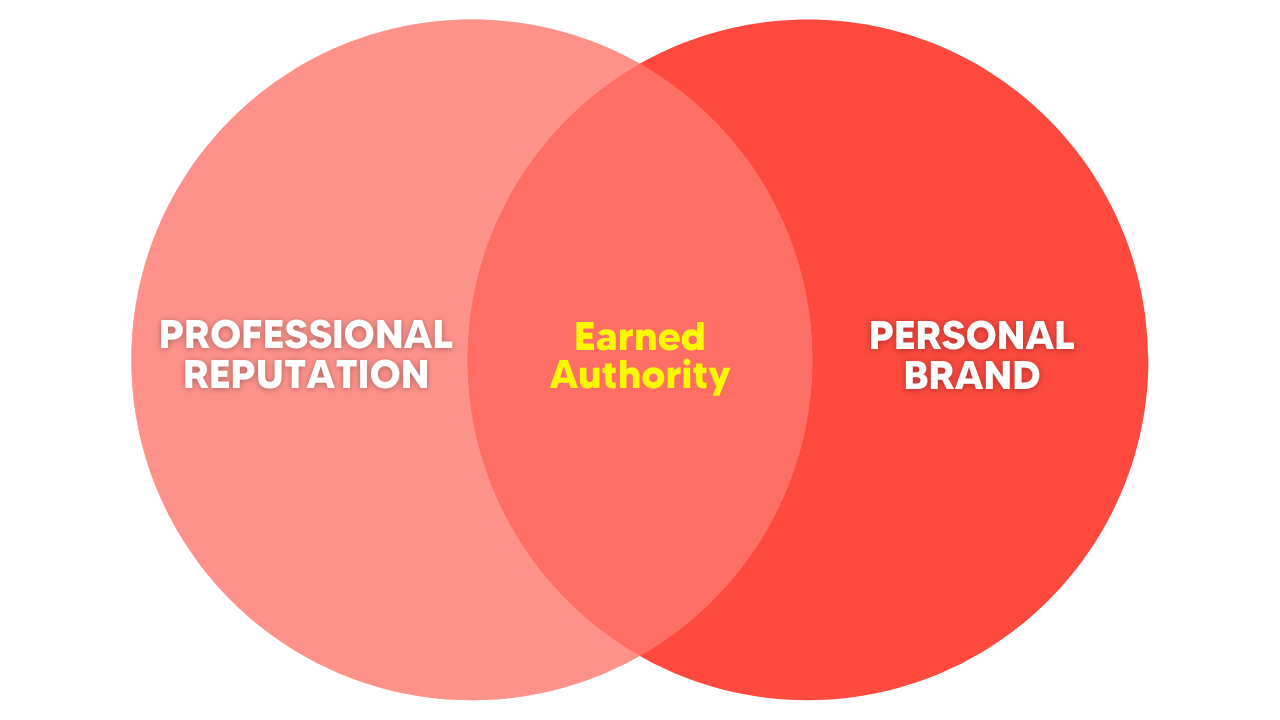
But reputation isn’t only built behind closed doors. There’s a category of activity that sits between “doing great work” and “broadcasting your personal brand” - actions that create external evidence of your expertise without being self-promotional in nature.
This includes:
- third-party validation - being quoted in industry publications, cited by peers, invited onto podcasts rather than pitching yourself.
- contribution to your field - writing that advances thinking rather than recycles it, mentoring others, serving on committees where the work matters more than the visibility.
- showing up in rooms you don’t control: hallway conversations at conferences, how you behave on someone else’s podcast, what you say when you’re not holding the microphone.
These aren’t personal branding activities, but they’re not invisible either.
They’re visible demonstrations of substance - proof points that others create or validate on your behalf. This is where PR and communications come into play - not as spin, but as the strategic effort to ensure your reputation has a chance to reach people who haven’t worked with you directly.
Leverage through personal brand
Then, use personal brand to amplify that reputation.
Once you have genuine expertise and real results backing you up, strategic communication helps you reach more of the right people and articulate your value clearly. Your personal brand becomes a true reflection of your reputation, not fiction about your aspirations.
This means sharing your authentic perspective on industry problems, not generic advice everyone else is recycling.
It means documenting your actual work and learning process transparently, not just highlighting wins. It means being consistent in communication style and values across platforms - people should recognise your voice and principles wherever they encounter you.
And it means focusing on usefulness to your ideal audience rather than impressiveness to everyone.
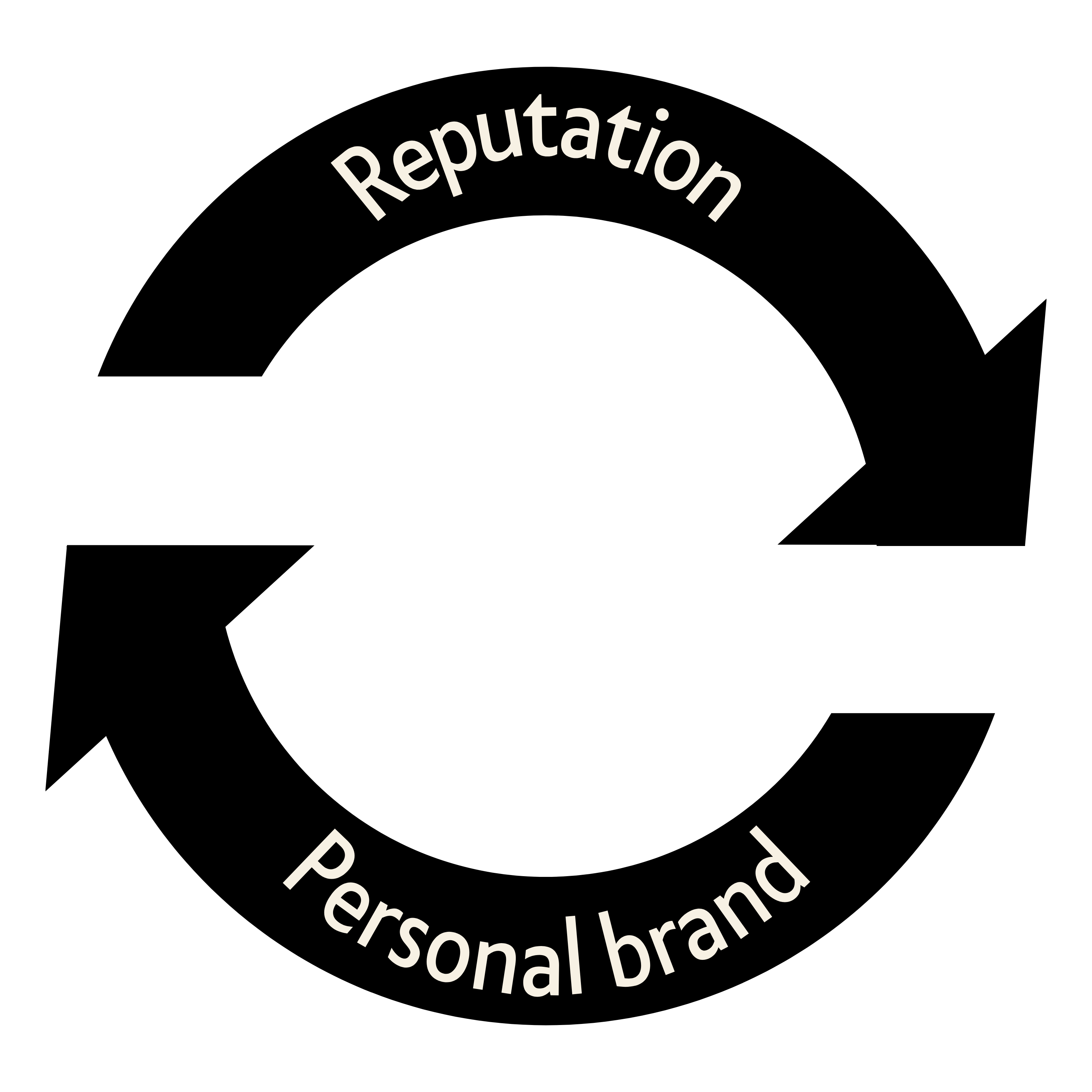
Here’s the kicker - if your reputation supports your personal brand:
- your personal brand communications will reinforce and enhance your reputation,
- and your reputation will add weight and gravitas to your personal branding efforts. Win-win!
The long game
We’re talking longevity and sustainability here. Being in it for the long haul, purposefully meshing brand and reputation ongoing for the benefit of your business and your career.
REMEMBER:
Personal brand gets you noticed. It opens doors, creates opportunities, and helps the right people discover your work. In a crowded market, visibility matters. If you’re genuinely excellent but nobody knows you exist, your impact remains limited.
Reputation keeps you there. It’s what converts initial interest into lasting relationships. It’s why clients become advocates, why opportunities compound over time, and why your business or career becomes more sustainable rather than fragile as it grows.
When reputation validates your personal brand, you occupy a powerful position. What you say about yourself aligns with what others experience and report. This congruence creates credibility that’s nearly impossible to fake. This in turn fosters trust - perhaps the rarest of commodities today.
For those ready to get serious
If you’ve been in the professional trenches for decades, you already have a reputation. The question you need to ask yourself is whether it’s strong enough to support the personal brand you’re about to proactively build.
Many entrepreneurs and professionals who’ve executed on personal branding sporadically decide at some point to get serious about it - more consistent content, clearer positioning, greater visibility. That’s the right instinct. But before you turn up the volume, take an honest look at the foundation.
Are there holes in your reputation that need fixing? Relationships you’ve let drift? Commitments you didn’t honour? Work that wasn’t your best? These things have a way of surfacing precisely when your visibility increases.
This isn’t either/or, by the way. You don’t pause personal branding until your reputation is perfect. But you do need to pay attention to both - reinforcing the foundation even as you build the bridge.
Put as much time into your reputation as you do your personal brand. When the foundation is solid, the brand works harder.
Onwards!
TY
In case we haven’t met yet …
Hi, I’m Trevor. I help genuine founders, experts and thought leaders build visibility, influence and trust - on their terms, in their voice.
Would you like to discuss how I can help you in a mentoring capacity to build your profile and reputation as a trusted and credible expert or thought leader in your industry? CLICK HERE TO BOOK A NO-OBLIGATION 20-MINUTE ZOOM CALL