Why failing to evolve your voice is the quickest path to professional irrelevance


In this article, I take a look at the importance of evolving our voice in the marketplace.
But first, what constitutes one’s ‘voice’? I’m talking in terms of reputation and personal brand - credible founders, professional experts and solo practice owners who are active in the marketplace writing blog articles and LinkedIn posts, publishing videos, doing podcast interviews, speaking on stages, posting social media comments etc.
Here’s my definition:
Voice is the consistent, recognisable expression of your professional identity - your perspective, values, and expertise made visible through every piece of content you create and every interaction you have, on and offline.
If our voice is inconsistent, not only do we dilute our authority-building efforts, but we also run the risk of confusing people. It’s hard enough to cut-through with our story and our message today without ‘kicking an own goal’ by muddying the messaging waters.
Okay, now on to the catalyst for this article →
How to map the evolution of your (blogging) voice
Did you know that if you have a blog on your website, you can use ChatGPT to show how your writing and ideas have progressed over time?
If I had to describe this exercise, I’d call it “Mapping the evolution of one’s (blogging) voice”. Whatever you want to call it, it’s a very interesting activity to do!
Mark Masters
This is how Mark outlined it in a LinkedIn post this week:
If your website is your source material, this is for you. It’s all from your ‘post-sitemap.’ It’s easy to do. Follow these steps
- Get your sitemap via “thenameofyourwebsite” + add ‘/post-sitemap.xml’ at the end
- Right-click the page and ‘Save As…’
- Save it as ‘post-sitemap.xml ‘on your computer
- Then add the .xml to ChatGPT
- Ask ChatGPT to analyse your content evolution, core themes and growth eras to show who you have become

“What you get back isn’t just data, it’s a perspective on the work you have produced,” Mark says.
“Most of the time, we are so close to our own work that we can’t see the story we’re actually telling.
“Doing this helps you to step back, to spot the threads, your progress and perhaps rediscover your own voice.”
I gave it a go, and it got me thinking … 🧐
I tried out the exercise Mark outlined in his LinkedIn post; see below for the summary of what came back - I found ChatGPT’s audit summary to be pretty damn accurate.
But more importantly, the whole exercise got me thinking about professional evolution, specifically as it pertains to our voice, and how we can/do/should evolve our external personal brand communications over time.
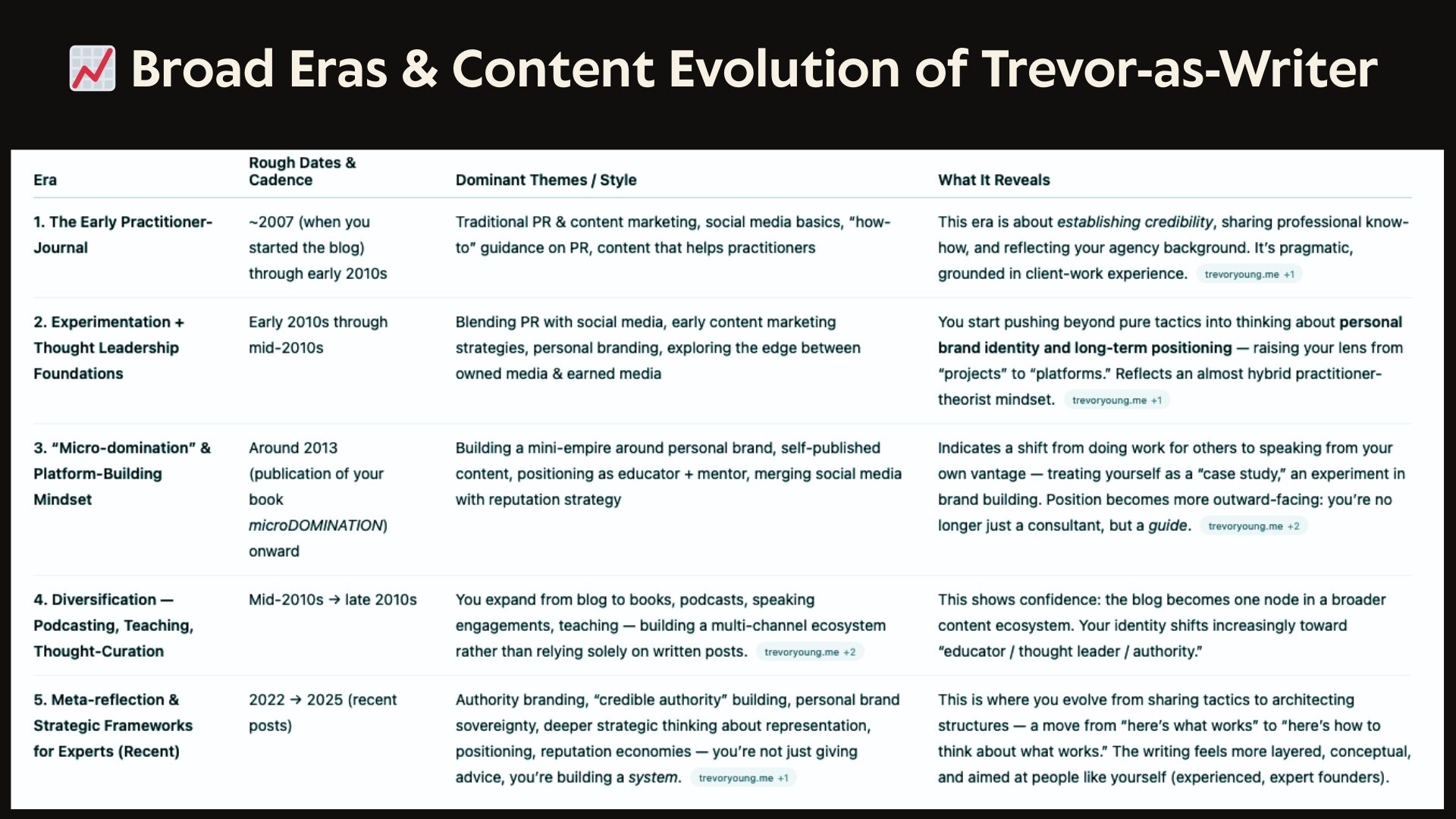
I’ve been posting articles online for nearly 20 years, starting in 2007 when I kicked off this PR Warrior blog on the old Typepad platform, before moving it across to a WordPress site a few years later, where it remains today, fully updated.
I know my voice has evolved significantly from those early days, but seeing it laid out like this, independently ‘audited’ by AI, has given me pause for thought:
- Has my ‘intellectual path’ been natural, or erratic?
- Have I confused people along the way?
- Is my voice today representative of who I am and how I want to be perceived?
Crucially, deeper analysis of ChatGPT’s audit shows a progression of thinking, insights, ideas and output, but also quite a few core themes and recurring motifs i.e.
“Across time - even as your focus shifted - some themes remained persistent; others evolved in nuance or intensity.”
For example:
- Authenticity and substance over noise
- Bridging owned, earned and social media
- Personal branding as strategic asset - not vanity
- Empowering experts, not just businesses
This was music to my ears 🎶 … I’ve always endeavoured to remain consistent with a set of recurring core themes, values and philosophies that infuse my work and my content. I think this is something all of us, as content-creating professionals, need to be aware of. I might do a follow-up piece on this topic 😉
Why it’s important to continually evolve
Given our voice is the consistent, recognisable expression of our professional identity, then naturally, we want to be always moving forward, to be evolving what we say and how we say it, mindful that our direction needs to be purposeful and, preferably, strategic.

These days, I’m way more strategic in how I put my voice out there, but in the early days, not so much. Before, I was just exploring new thoughts and ideas in public; today, however, I still do that, but with a strong foundation of core themes, values and philosophies underpinning everything.
Bottom line: As we evolve as business owners and practitioners, it’s imperative that our voice - our content, communications, interactions - evolve as well. There shouldn’t be a lag or gap between who you are as a professional (your thinking, your IP, your knowledge and experience, your service offering) and the external communication thereof - this will only confuse the marketplace and potentially breed distrust.
How do we evolve our voice in the marketplace?
Speaking from first-hand experience - plus working with and researching hundreds of thought leaders and content-creating entrepreneurs - I can put my finger on a few (somewhat overlapping) things when it comes to evolving our voice:
- POINT OF VIEW - This pertains to all of our content and communications efforts: Is our point of view sharper now than a year or so ago? Are we being more pointed, more controversial, more thought-provoking, more vulnerable, more philosophical? Are we adding depth to our work, or broadening (or reducing in size) our intellectual territory, or expanding on the topics and issues we want to be known for? In my case, as you can see from the graphic above, I’ve shifted from “traditional PR & content marketing, social media basics, how-to guidance on PR, content that helps practitioners” in the early days, to now where, according to ChatGPT’s audit, I am focusing more on “authority branding, personal brand sovereignty, deeper strategic thinking about representation, positioning, reputation economies” etc. My point of view has changed significantly, albeit over a period of time and through different professional phases. Indeed, the lexicon I’ve developed and used continues to evolve as well.
- WRITING STYLE - Are we evolving how we write? Are we focusing on producing thoughtful longer form content, or veering more towards shorter, punchier articles? Maybe we’re incorporating interviews and telling other people’s stories, or curating/expanding upon big picture ideas in our writing? Are we putting more of ourselves in our words i.e. more personal stories? In my case, I’ve doubled down on longer-form articles in more recent times; in turn, these articles can be effectively repurposed into shorter posts for social media.

- SOCIAL MEDIA EXPERIMENTATION - Are we continuing to stick to one social media platform, or signing up for - and experimenting with - other social channels? Most of you are probably on LinkedIn, but have you actively (and enthusiastically) experimented with, say, Instagram, or Twitter/X? In my case, I’ve always had a couple of mainstay social channels - LinkedIn and Twitter - but have played around with all the others e.g. Instagram, Facebook, TikTok, YouTube at various times. I’ve done this, in part, because it’s my job to be across these platforms, but regardless, it’s been important to see if I can extend my voice into different social channels.
- EXPERIMENTING WITH MEDIA FORMATS - This ties into social media experimentation; if you’ve established yourself as a writer, have you experimented with long-form video? Short-form video? Podcasting? Are you adding public speaking to your communications kit bag, or podcast interviews? In my case, I started as a blogger and concurrently on social media, then branched out into audio (podcasting) and video (for YouTube, plus TikTok, Instagram etc). Even within the constraints of these formats, I continue to experiment - for example, I’ve recently evolved my EARN THE RIGHT podcast - taking it from a standard interview-based podcast to a multi-track audio channel.
- CONDUCTING RESEARCH - Are you conducting your own research with a view to incorporating the resultant insights into your professional offerings, or your content, or both? In my case, my research is by no means structured; it’s ongoing via reading books and long-form articles, listening to podcasts, following smart people on social media and taking note of what they have to say, and reading research reports conducted by third-party organisations. I’m a bit of an ‘informational bowerbird’ - I take ideas and insights and scraps of information from multiple sources and, when it makes sense to do so, join the dots during my writing process. This ongoing work forms the backbone of my own professional evolution - I stop doing this, I cease to evolve. If I cease to evolve, undoubtedly I will fade into professional irrelevance.
- CREATING SIGNATURE FRAMEWORKS, MODELS & PROCESSES (IP) - This is where it gets really interesting: are you taking your thinking, ideas and insights, and then developing different frameworks, models and processes? This work inevitably will dovetail from any sustained research you do, and is a terrific way to build a reputational ‘moat’ around your professional brand. Incorporating such frameworks and IP into your content will only strengthen and enhance your voice in the marketplace. However, failure to evolve your ideas and IP in line with changes in the marketplace might see you stagnate professionally (obviously, this will largely be dependent on the industry in which you operate). In my case, models and frameworks are something I’ve been developing and fine-tuning over the past eight years or so; given I work in an ever-changing media environment, I’ve needed to constantly refine my IP, something I share often through my content. Some of the frameworks I’ve created have stood the test of time, but have been tweaked over the journey e.g. my 4 Authority Content Lenses model.
Be aware of the risks, however …
As always, we need to be aware that evolution in our mind might appear to be “rapid change” in the eyes of our clients, peers, connections and broader professional community.

We need to be cognisant of the potential disconnect between how we’re seen currently, and how we’ll be perceived after a period of professional change (evolution, reinvention, call it what you want).
For example, and without naming names, there was one fellow who dominated social media and blogging in the early days who I used to follow and admire, but he was forever switching things up - what he did as an entrepreneur, the content he produced and the topics he covered. This guy might have seen it as professional evolution, but in my eyes he was constantly zig-zagging all over the place, so much so that I gave up following (and purchasing from) him after several ‘reinventions’.
Nothing wrong with professional reinvention, by the way, as long as it’s purposeful, and your content-led communications - your voice - are aligned with your new business model or the professional image you’re trying to project. Again, everything must be in-sync otherwise you run the risk of confusing people and they’ll drop off you.
Running that ChatGPT audit on my own content was a useful reminder: evolution isn’t about abandoning who you were, but building on it. The threads that ran through my earliest posts are still there today, just sharpened and refined.
So here’s the question worth sitting with: Is your voice today an evolved expression of who you’ve become professionally? Or are you still communicating like the person you were three years ago?
Onwards!
TY
*** THIS ARTICLE WAS FIRST PUBLISHED ON EARN THE RIGHT ***
In case we haven’t met yet …
Hi, I’m Trevor. I help genuine founders, experts and thought leaders build visibility, influence and trust - on their terms, in their voice.
Would you like to discuss how I can help you in a mentoring capacity to build your profile and reputation as a trusted and credible expert or thought leader in your industry? CLICK HERE TO BOOK A NO-OBLIGATION 20-MINUTE ZOOM CALL